














Not ready for a demo?
Join us for a live product tour - available every Thursday at 8am PT/11 am ET
Schedule a demo
.svg)
No, I will lose this chance & potential revenue
x
x



Your developers are shipping more code than ever, but you don’t actually know how much of it they fully understand.
AI coding assistants are now embedded in daily workflows, shaping how code gets written, structured, and shipped. Teams move faster, generate more output, and rely on suggestions that influence real implementation decisions. The speed looks like progress, but it comes with a tradeoff that most security teams haven’t accounted for.
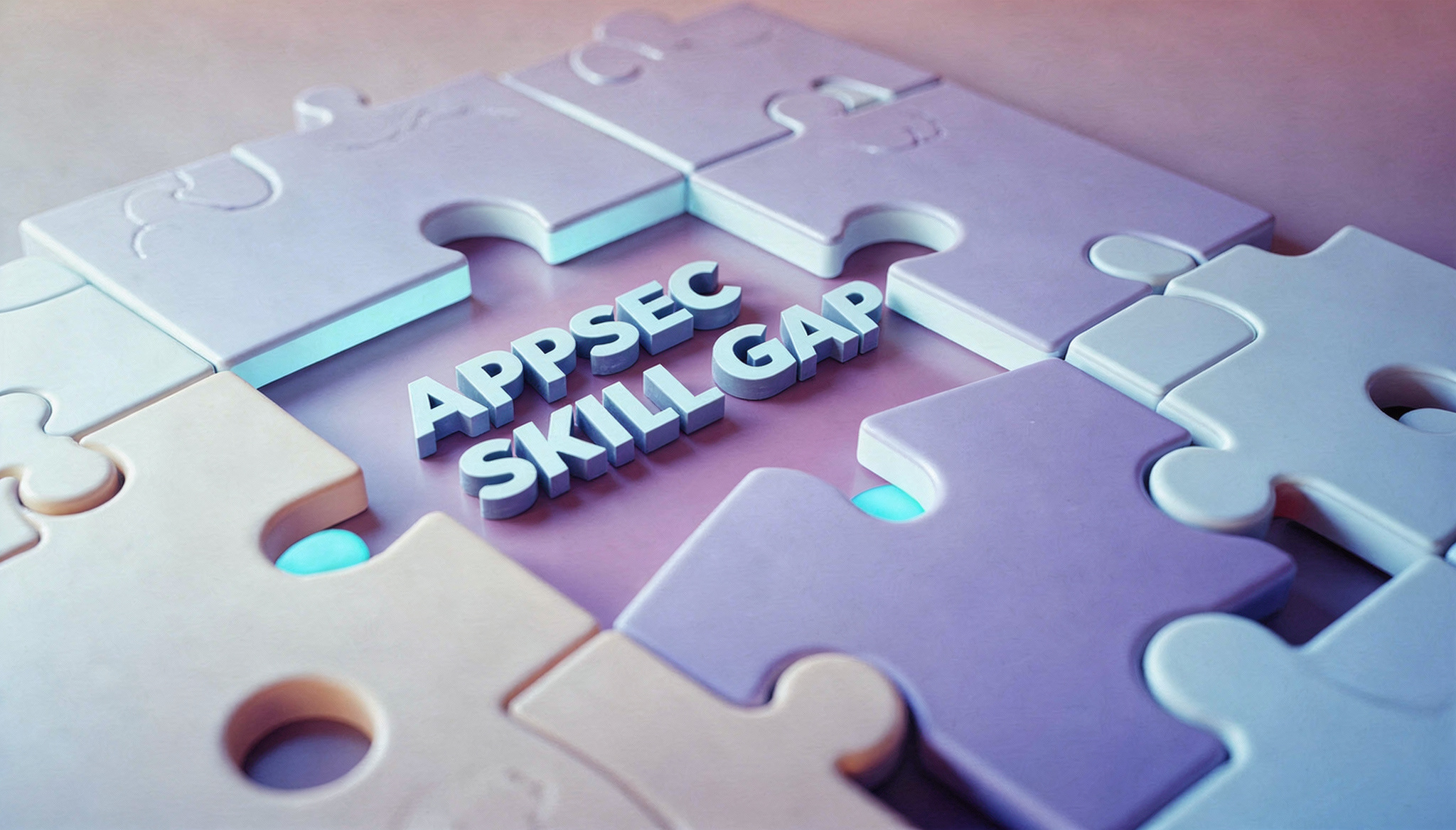
AI coding assistants are creating a new AppSec skill gap. Code volume is rising, context is shrinking, and your team is left reviewing software that no one fully reasoned through. That means more attack surface, harder-to-spot flaws, and growing pressure on a small group of experts who are already stretched thin.
So…as AI accelerates development, are you still in control of the security outcomes?
Code is no longer written the way your security processes assume it is. Developers still own the commit, but they’re not always the ones producing the logic. AI coding assistants now generate entire functions, suggest architectural patterns, and fill in integrations that would have taken hours to write manually. The change is subtle in the workflow, but significant in impact. Code gets accepted faster, often after a quick review of whether it works, not how it works.
That changes the foundation AppSec has relied on for years.
The core issue is how development decisions are being made. When a developer writes code from scratch, there’s intent behind structure, validation, and control flow. With AI-assisted coding, that intent gets diluted. The developer evaluates output instead of constructing it, which means parts of the logic are accepted without full understanding.
This creates a new reality:
At that point, asking who wrote this? stops being a simple question.
Traditional AppSec models depend on a few implicit assumptions:
AI-assisted development breaks each of these. You now review code where parts of the logic were suggested, accepted, and shipped without deep validation. The code might pass tests, integrate correctly, and still carry risks that no one explicitly considered.
Take a common scenario. A developer uses an AI assistant to generate authentication logic or wire up an API integration. The code compiles, the flow works, and the feature gets shipped. Under the surface, you may find:
None of these show up as obvious errors during development. They sit quietly until exploited. The problem is that those parts of the implementation were never fully reasoned through.
AppSec reviews now operate with a blind spot. You see the final code, but not how it was generated, what assumptions the model made, or which parts were accepted without scrutiny. That means you’re no longer reviewing purely human-written code, but machine-influenced output at scale, without visibility into its origin or intent.
The skill gap in AppSec changed into something harder to detect and far more difficult to fix.
For years, the problem was capacity. You didn’t have enough AppSec engineers, and deep skills like threat modeling were concentrated in a small group. That constraint still exists, but it’s no longer the limiting factor. Development speed has outpaced the ability to reason about what’s being built, and security teams are now reviewing code patterns they never saw being designed. That creates a different kind of gap. One that tools alone can’t close.
AI-assisted development changes who carries the cognitive load. Developers can now generate complex implementations in minutes, but that doesn’t mean they understand the security implications behind them. Security teams inherit the output and are expected to evaluate it without visibility into how those decisions were made. What’s missing is the ability to reliably judge the security of that output.
Teams need to:
Without these skills, reviews become surface-level. Code looks correct, passes tests, and still introduces risk that no one explicitly evaluated.
Most secure coding programs were built around known vulnerability classes and static examples. That model assumes developers are writing code intentionally and can map what they write to known risks.
AI-assisted development breaks that link. Training that focuses on predefined categories like injection flaws or misconfigurations doesn’t help when the issue comes from how an abstraction was generated or how a framework was stitched together by a model. The risk shows up in how components interact, how data moves, and how edge cases are handled. These are not patterns you catch by memorizing vulnerability lists.
Static training also struggles to keep up with how quickly AI-generated patterns evolve. What developers see and use today may not resemble what training covered even a few months ago.
A developer can now generate an end-to-end implementation that includes authentication, API calls, and data handling in a single flow. It works, integrates cleanly, and gets approved quickly.
What often goes unexamined are the fundamentals that determine whether that implementation is secure:
When these questions aren’t asked, risk isn’t removed. It’s just hidden inside working code. The gap is no longer about adding more tools or increasing scan coverage. Your teams need the ability to evaluate what AI is producing with confidence. Without that, you scale development speed and uncertainty at the same time.
Your AppSec workflows were built around a predictable model. Developers design, write, and commit code in a sequence that gives security teams clear points of intervention. That predictability is what made reviews, scanning, and threat modeling workable.
But with AI-assisted development , code is generated faster than it can be reviewed, design decisions happen inside prompts instead of design docs, and implementation paths shift in real time. The result is a workflow where security controls still exist, but they no longer align with how code is actually being produced.
Most security reviews still happen after code is written and merged. That delay already creates risk in modern CI/CD environments. With AI, the gap widens.
Developers can generate large chunks of code in a single session, commit it quickly, and move on. By the time security findings appear, the context is gone and the codebase has already evolved. This leads to a familiar but amplified pattern:
The issue is now the volume and pace at which new code enters the system.
AI increases code output without increasing review capacity. Every additional line of code becomes a potential source of findings, which pushes existing tools into overload. Security tools respond the only way they can. They flag more issues. That creates a cycle:
At that point, the problem changes from detection to credibility. When developers stop trusting the output, the entire feedback loop breaks down.
Threat modeling depends on understanding how systems are designed before they are built. That assumption doesn’t hold when architecture evolves through AI-assisted suggestions.
A developer can generate service interactions, data flows, and integration patterns on the fly. These changes rarely go through structured design reviews, which means threat models become outdated almost immediately. Manual approaches struggle because they rely on:
None of these exist in a workflow where design and implementation happen simultaneously.
One of the biggest gaps is context. Security teams review the final code, but they don’t see how it came together. They don’t have access to:
That missing context makes it harder to assess risk accurately. You’re evaluating outcomes without understanding the decisions that produced them.
Consider a common scenario. An AI assistant suggests a microservice interaction pattern that simplifies communication between services. It works efficiently and gets adopted quickly. What goes unnoticed is the implicit trust introduced between those services, with no authentication or validation at the boundary. No one flags it during development because it looks like a valid pattern. The issue only surfaces when that trust is exploited.
Your current AppSec model assumes that development follows a predictable path with clear checkpoints and visible decisions. AI-assisted development removes that predictability, which means those checkpoints no longer provide the coverage you expect.
Security doesn’t break because you lack tools, but because the people making day-to-day implementation decisions aren’t equipped to judge risk in real time.
AppSec teams were never designed to scale linearly with development. Headcount stays relatively fixed while codebases grow, architectures expand, and release cycles compress. AI accelerates that imbalance. Developers can now generate and ship significantly more code without increasing the time spent reasoning about it, while security teams are still expected to review, validate, and catch issues downstream.
The first meaningful security decision no longer happens in a review or a scan. It happens at the moment a developer accepts or modifies AI-generated code. That includes decisions like:
These are not small choices. They define the security posture of the application before AppSec ever sees the code. If developers don’t have the ability to evaluate these decisions critically, security becomes reactive by design.
What developers need now goes beyond secure coding basics. The challenge isn’t identifying a known vulnerability pattern after the fact, but recognizing when something feels correct functionally but introduces risk structurally. That requires the ability to:
These are judgment skills that need to show up during implementation instead of training modules or compliance exercises.
Most current training approaches don’t change behavior because they sit outside the development workflow. Developers complete modules, pass assessments, and return to writing code the same way they did before. What works looks very different. Training needs to be:
When developers practice evaluating and modifying code in realistic contexts, they build the judgment required to handle AI-assisted development. Without that, training becomes a chore and risk continues to scale with code output.
You don’t fix this problem by adding another tool or tightening an existing control. You fix it by changing how security operates inside the development lifecycle.
AI-assisted development has already changed where decisions happen. Security needs to move to those same points, or it becomes an after-the-fact function that can’t keep up with how code is produced.
Secure coding used to mean writing code that avoids known vulnerabilities. That definition assumes the developer is the sole author of the logic. That assumption no longer holds.
Secure coding now includes validating AI-generated code before it gets accepted. Developers need to treat generated output as untrusted input, even when it looks correct and integrates cleanly. If that validation step is missing, insecure patterns move straight into production under the appearance of working code.
Security signals that arrive after code is merged are already too late. With AI increasing code velocity, that delay creates a growing gap between development and review. Security needs to show up where developers are actively making choices:
This is where developers decide what to accept, modify, or reject. If security guidance doesn’t exist at that point, it gets bypassed by default.
Expanding your tool stack won’t solve a judgment problem. Scanners can identify patterns, but they don’t replace the ability to understand whether an implementation is safe in context.
Teams need the ability to reason about risk as they build. That includes understanding how generated code behaves across services, how data moves through the system, and where trust boundaries actually exist.
Without that capability, more tools only increase noise and slow down decision-making.
AI-assisted mistakes repeat quickly. If a developer accepts an insecure pattern once and doesn’t understand why it was wrong, that same pattern will show up again across multiple services and features. Feedback needs to be clear, timely, and tied to real code:
When developers see the consequence of a decision and understand the reasoning behind it, behavior starts to change. Without that loop, security findings become background noise.
Tracking who completed training or acknowledged a policy doesn’t tell you anything about risk. What matters is whether developers can identify and fix security issues in real scenarios. That requires measuring outcomes inside the workflow, not completion metrics outside of it. Look for signals like:
These are indicators of capability, and they directly affect how much risk reaches production.
This isn’t about upgrading your tooling stack, but about changing how security operates, where it shows up, and what skills it prioritizes. If your model doesn’t adapt to how development actually works today, it won’t matter how many controls you add around it.
You now have a development model where code is generated faster than it can be understood, and security decisions are made at the moment of acceptance.
That shows up quickly in production. Vulnerabilities slip through because no one questioned the implementation. Incident response slows down because no one fully understands the logic. A small group of security experts becomes the bottleneck, and they still lack the context needed to catch what matters.
You close this gap by building security capability where decisions happen. AppSecEngineer’s AI and LLM collection, along with its secure coding tracks, gives your developers hands-on experience evaluating AI-generated code, identifying insecure patterns, and making correct implementation choices inside real workflows. That’s how you scale judgment across teams instead of relying on downstream controls.
If your developers are already using AI to ship code, it’s time to make sure they can secure it.


.png)

Koushik M.
"Exceptional Hands-On Security Learning Platform"
Varunsainadh K.
"Practical Security Training with Real-World Labs"
Gaël Z.
"A new generation platform showing both attacks and remediations"
Nanak S.
"Best resource to learn for appsec and product security"
.svg)


.svg)

Koushik M.
"Exceptional Hands-On Security Learning Platform"
Varunsainadh K.
"Practical Security Training with Real-World Labs"
Gaël Z.
"A new generation platform showing both attacks and remediations"
Nanak S.
"Best resource to learn for appsec and product security"

.svg)
United States11166 Fairfax Boulevard, 500, Fairfax, VA 22030
APAC
68 Circular Road, #02-01, 049422, Singapore
For Support write to [email protected]

